The Wild Lagoon Hiding Right Next to the Runway
Right Beside the Runway, a Completely Different Algarve Begins
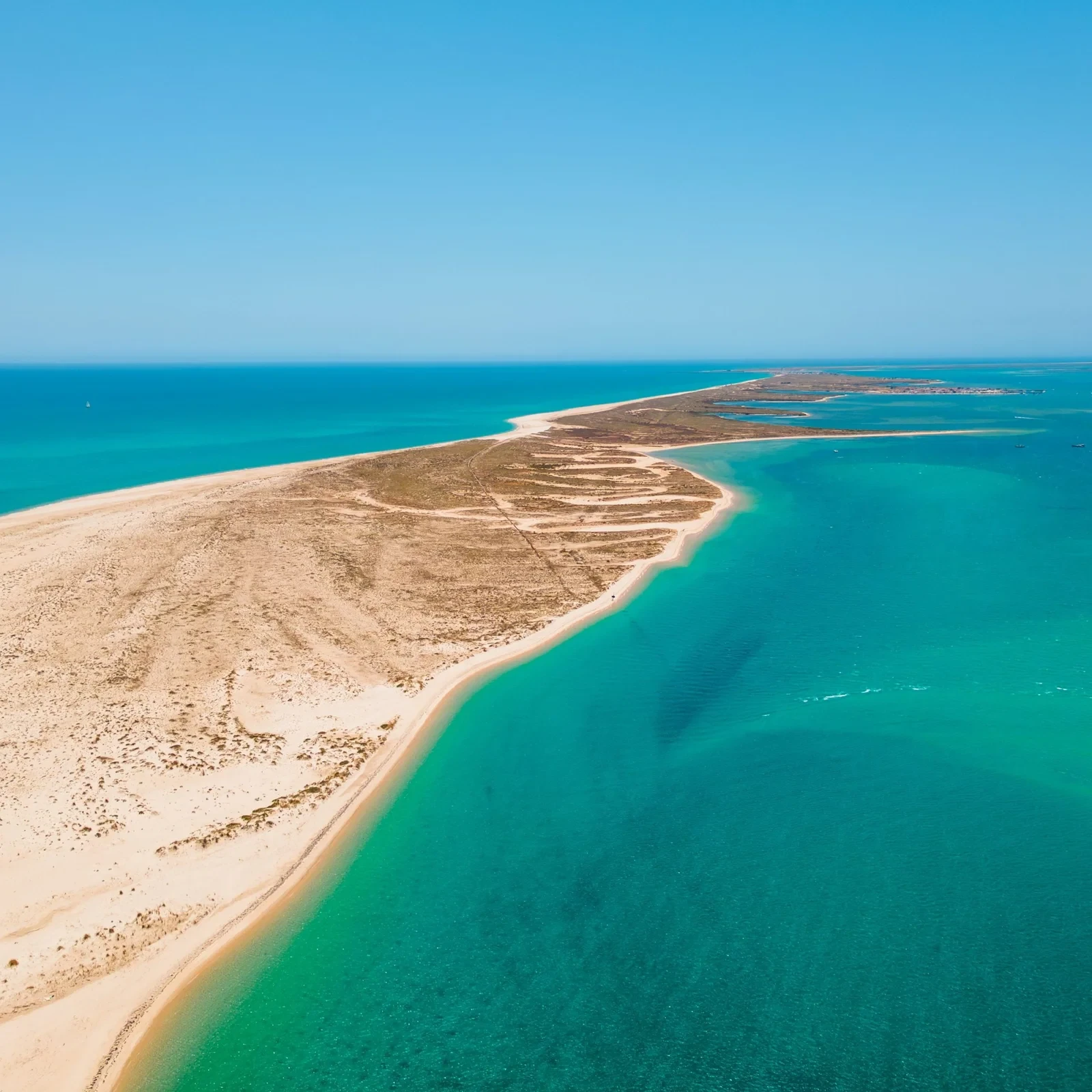
If you’ve ever flown into Faro, you’ve already seen Ria Formosa, even if nobody told you its name. In the final minute or two before landing, the plane drops low over a sprawling maze of channels, sandbanks and silver-green water that looks almost too intricate to be real, before the wheels touch down a few hundred metres from where it ends. Most passengers glance out the window for ten seconds, decide it looks nice, and forget about it by the time they’ve found the hire car desk. Which is a shame, because that maze is one of the strangest and most overlooked places in the whole Algarve.
A Landscape that Doesn’t Sit Still
Ria Formosa isn’t a single lagoon so much as a 60-kilometre system of barrier islands, sandbars, salt marshes and tidal channels running along the south eastern coast, roughly from the Quinta do Lago area in the west to Cacela Velha and Manta Rota in the east. Unlike most of the coastline tourists picture when they think “Algarve” (cliffs, coves, fixed in place for millennia), Ria Formosa actually moves. Its islands shift shape with the tides and currents, and the whole system was dramatically rearranged by the great earthquake of 1755, the same one that flattened much of Lisbon. It’s still rearranging itself today, just more slowly, with every storm nudging sandbanks a little further along the coast.
That makes it a slightly unsettling kind of nature reserve. Most protected landscapes are protected because they’re meant to stay exactly as they are. Ria Formosa is protected while actively refusing to stay still.
Wildlife
Mediterranean chameleons, an animal most visitors don’t even realise lives in Europe, hide in the dune scrub. Storks nest on rooftops nearby, and more than 30,000 migratory birds pass through annually, using the wetlands as a motorway service station on much longer journeys between Europe and Africa.
Birdwatchers tend to single out one bird in particular: the purple gallinule, a chicken-sized wading bird with a blue-purple body, a bright red beak, and legs that look borrowed from something twice its size. People who spot one for the first time often assume they’re hallucinating slightly in the heat.
No Cars, No Rush
What makes Ria Formosa genuinely unusual, though, isn’t just the wildlife. It’s that people still live inside it, doing more or less what their grandparents did. Ilha da Culatra is the only island in the lagoon inhabited all year round, home to somewhere between 750 and 1,000 people spread across three tiny settlements: Culatra itself, Farol near the old lighthouse, and a small cluster called Hangares in between. There are no roads anywhere on the island, and never have been. Ferries are foot-passenger only, so the only ways to get around are on foot, by bicycle, or by boat, and the whole place runs on tides rather than traffic.
The harbour is where the island actually happens. Fishermen mend nets and unload the morning’s catch within sight of the oyster beds that line the channels nearby, and the houses around the port are often decorated with the tools of the trade, buoys, old nets, anchors, as much a part of the architecture as the whitewash. Despite the lack of cars, Culatra isn’t a museum: it has a school, a kindergarten, a church, a small health centre and a grocery store, enough to function as a genuine, self-contained community rather than a holiday backdrop. Residents who summer there talk about a particular kind of freedom that comes from there being nowhere to rush to: ordering tomorrow’s bread the evening before, sending the kids to collect it themselves the next morning, an ice cream at the end of the day counting as the day’s main event. Even the bar by the beach at Farol still closes at five.
That simplicity is the whole point, and it’s worth sitting with rather than rushing past. Lunch on Culatra usually means whatever came off the boats that morning, served without much ceremony: grilled squid, a plate of clams, maybe a tuna steak, eaten at a table a few metres from the water with a glass of chilled white wine. There’s no real entertainment beyond what the island already offers, watching the boats come and go, walking the sand, waiting to see what the tide uncovers, and that turns out to be enough. Walk far enough past the houses and the crowds thin out completely, leaving long stretches of empty beach where the only sound is the wind and the occasional gull.
It’s a strange kind of luxury, especially for visitors arriving from somewhere with a constant hum of notifications, traffic and things to be somewhere for. On Culatra, the biggest decision of the day might be which restaurant has the better view, and the best entertainment is genuinely just watching fishermen mend their nets while the light changes over the lagoon. That’s precisely why it’s worth the ferry ride: not for a list of sights to check off, but for a few hours where the only schedule that matters is the tide’s, and the only thing expected of you is to slow down enough to notice it.
All of this exists within a few minutes’ boat ride of an airport that handles close to 10 million passengers a year. Take one of the boat tours that leave from Faro’s marina and you’ll likely pass directly beneath the flight path, watching aircraft appear to take off out of what looks, from the water, like open marshland. It’s a genuinely strange juxtaposition: jet engines and hand-raked salt pans sharing the same horizon.
Worth More than Ten Seconds
None of this is hidden, exactly. Boats leave regularly from Faro, Olhão and Tavira out to islands like Ilha Deserta (uninhabited and about as close to untouched as the Algarve gets), Armona (a quieter, family-friendly stretch of colourful cottages) and Culatra itself. Entry to the main visitor area, Quinta de Marim, costs a few euros, and guided walks will point out birds and salt pans that are easy to miss on your own.
But most people flying into the Algarve never make the trip. They see the lagoon for ten seconds from 500 feet, then spend their holiday a short drive away without ever setting foot in it. Which means one of the more genuinely wild, strange, slow-moving corners of southern Europe sits in plain sight of nearly every visitor to the region, and almost nobody stops to look properly.
If you would like to write an article for our Lifestyle page about Portugal or boating life we would love to hear from you.
Please send your article for review to [email protected]
Ready to Experience This?
Book your Ria Formosa Luxury Morning Charter today
Book Ria Formosa Luxury Morning Charter Now